Beats, bars, phrases
This section is about about the various time units in dance music,
and how they relate to concept you may know from dancing. There are
the beats, which are similar to single dance steps. Taking a few beats
together gives you a bar or measure, just like a few steps give you a
pattern. Bars combine to give phrases, just as from a few patterns
you build an amalgamation, and from phrases you build a song the way you
string amalgamations together into a routine that will last a whole
song.
However, the correspondence I have just sketched is only by analogy.
This page will teach you exactly what the similarities and the differences
are.
If you haven't done so already, please read the Introduction to music notation.
Dance rhythm and structure: beats, bars, patterns
Beats
In conversations about music you will often hear the word beat.
People will say This song has a good beat or The guitar has a
intro of eight beats. In the first sense of the word beat is almost
synonymous with rhythm, and that is a concept that we will go into
later on. Right now we are focussing on the second sense, where beats
are things you can somehow count. Here is the clearest example: if the band
leader counts down "One, two, three, four!", he has just counted
four beats. Beats, then, are the basic units of counting dance
music. They are what you tap your foot to if the music has an
infectuous rhythm.
How do you find what the beats are? In some music they are very easy
to hear. For instance, in some bluesy music the bass may play a walking bass pattern. In disco
music it is the bass drum that plays boom boom boom boom, one boom
per beat. In such cases it is easy to find the beats: just count along with
the instrument doing the "boom"ing.
In other cases there is no one instrument that you can listen to
for the beat: you need to listen to the whole amalgam, and pick out
the beat from that. Most of the times it will still be clear what the beat
is, but in some cases people may disagree
on precisely what are the beats.
Bars
A bar is a repeating group of beats, for example three counts in a waltz (this is called a ternary
rhythm) and two or four counts in most other dances (this is called
a binary rhythm). Usually you can easily recognise
the bars.
 Waltz has a distinct "Oom pah pah" feeling,
that is, one heavy beat and two lighter ones. The heavy note is usually
played by the bass - reinforced by the bass drum of the drumkit, if one
is present - while the two lighter ones can be played by lighter sounding
instruments such as rhythm guitar in country waltz, or not be accentuated
at all in ballroom waltz. In that case you can tell the two light beats
only by listening to the vocal melody.
Waltz has a distinct "Oom pah pah" feeling,
that is, one heavy beat and two lighter ones. The heavy note is usually
played by the bass - reinforced by the bass drum of the drumkit, if one
is present - while the two lighter ones can be played by lighter sounding
instruments such as rhythm guitar in country waltz, or not be accentuated
at all in ballroom waltz. In that case you can tell the two light beats
only by listening to the vocal melody.
For the rhythms of most other dance the feel is "Left
Right" or "Up Down", that is, two beats. A lot of music has four beats to the bar, often
with a clear "left right left right" feel. But hold on a
second: "left right left right" is twice a repetition of two
beats. So why is this notated as one bar of four beats rather than two
of two? Partly it is a matter of convention and tradition whether binary rhythms are presented as having two or
four beats to the bar. Traditionally, Samba, Merengue, Polka, and Paso Doble are presented with two
beats to the bar; all other binary rhythms are notated with four beats
to the bar. Apart from convention there is another reason for notating
music with four beats to the bar; see below.
A lot of music has four beats to the bar, often
with a clear "left right left right" feel. But hold on a
second: "left right left right" is twice a repetition of two
beats. So why is this notated as one bar of four beats rather than two
of two? Partly it is a matter of convention and tradition whether binary rhythms are presented as having two or
four beats to the bar. Traditionally, Samba, Merengue, Polka, and Paso Doble are presented with two
beats to the bar; all other binary rhythms are notated with four beats
to the bar. Apart from convention there is another reason for notating
music with four beats to the bar; see below.
Bar length versus pattern length
Musicians who start to dance are almost invariably puzzled, not to say
confused, by the fact that music with four counts to the bar is used for
dances that have six (as in swing, foxtrot, country two-step) or three (as in hustle) counts to the
pattern. "It does not fit."
The thinking behind this confusion is something along the following
lines. Music is a sequence of bars, and they are each counted the same
way, for instance one two three four. Also, each bar has a
rhythm that largely repeats in the next bar. Shouldn't dance patterns,
which each have the same repeating rhythm, then also repeat, and in
sync with the music?
In many dances, the rhythm of the basic pattern and the rhythm of the
music are indeed closely matched. For instance, the rumba dance rhythm is
Slow Quick Quick; this takes four counts, that is, exactly one bar,
and it repeats the next bar. There is then an exact correspondence
between one bar of music and one basic dance rhythm. A similar
story holds for waltz, chacha, merengue, salsa, et cetera.
For these dances we can say that the start of a pattern always
coincides with the start of a bar of music*. We do have to remark that for salsa and
rumba every other pattern starts on the other foot (first you do a
quick-quick-slow starting on the left foot, then quick-quick-slow
starting on the right foot), so even though
the basic rhythm repeats every bar, the footwork repeats only every
other bar. Stil, even in these dances there is a simple correspondence
between bars of music and dance patterns.
However, there are the dances mentioned above where no such simple
alignment of dance patterns and bars of music exists. Basically, this
observation is correct and there is no way around it. A single pattern
can be shorter or longer than a bar of music, and that makes some
patterns start on the bar, and others in the middle of a bar of
music. There is nothing to do but to get used to this fact.
We can still salvage the alignment to an extent.  Look at dances such as swing or foxtrot or country
two-step that have six-beat patterns. Two of these patterns together
fill up three whole bars of music. For example, in this example you
see two basics of country two-step, each counted QQSS. The
first basic runs to halfway the second bar, so the second basic starts
halfway the bar and runs till the end of the third. Now, the third
pattern -- and in general every other pattern -- will again start at
the beginning of a measure. In hustle the problem is slightly
different, but the solution is similar.
Look at dances such as swing or foxtrot or country
two-step that have six-beat patterns. Two of these patterns together
fill up three whole bars of music. For example, in this example you
see two basics of country two-step, each counted QQSS. The
first basic runs to halfway the second bar, so the second basic starts
halfway the bar and runs till the end of the third. Now, the third
pattern -- and in general every other pattern -- will again start at
the beginning of a measure. In hustle the problem is slightly
different, but the solution is similar.
Such dances  where the pattern has a different length from
the measure length are also confusing if you start counting. Do you count
the beats, or the steps? In dances like rumba there is no problem: you count
four beats per bar, and four beats per pattern. In a dance with a six-count
pattern you count four beats to the bar, but after four beats in the pattern
you still have two to go, while the musical count starts over at one. In
this example you see again two-step: the beats are counted over, and the
steps under, the rhythm. Most of the time, people count the dance steps,
not the beats, in such dances.
where the pattern has a different length from
the measure length are also confusing if you start counting. Do you count
the beats, or the steps? In dances like rumba there is no problem: you count
four beats per bar, and four beats per pattern. In a dance with a six-count
pattern you count four beats to the bar, but after four beats in the pattern
you still have two to go, while the musical count starts over at one. In
this example you see again two-step: the beats are counted over, and the
steps under, the rhythm. Most of the time, people count the dance steps,
not the beats, in such dances.
Dance phrasing
 To make the dance bear a relation to
the music it is set to, good dancers will fit dance phrases to musical
phrases. For instance, a lot of music has 32 beats in each chorus or
verse, that is, eight bars. Now, above you saw that using six-count
patterns you can fill three bars exactly with two basic patterns. And
three bars does not divide in eight: two groups of three makes six
bars and you have two left. Fortunately, dances with six-count
patterns also have typically have eight-count patterns, and these help
you out.
To make the dance bear a relation to
the music it is set to, good dancers will fit dance phrases to musical
phrases. For instance, a lot of music has 32 beats in each chorus or
verse, that is, eight bars. Now, above you saw that using six-count
patterns you can fill three bars exactly with two basic patterns. And
three bars does not divide in eight: two groups of three makes six
bars and you have two left. Fortunately, dances with six-count
patterns also have typically have eight-count patterns, and these help
you out.
- In foxtrot you can use a reverse turn with QQS QQS rhythm;
- in swing there are whip (or lindy) patterns with a 12 3&4
56 7&8 rhythm;
- in country two-step you can either use a double turn QQ QQ
SS, or some syncopations with a QQS QQS rhythm.
In order to phrase to the music, a dancer can now use four 6-count and
one 8-count pattern to line up the dance with the music. In this
example you see four normal swing patterns (each starting with a
rock-step or walk-walk depending on what kind of swing you dance),
followed by a final 8-count pattern, that is, whip or lindy
timing. Of course, the eight count
pattern can occur anywhere in the phrase; it does not have to be at
the end.
Musical rhythm, phrasing, and structure
A lot of western popular music is based on divisions in two and four.
You already saw above how heavy and light beats alternate, and how a four-beat
measure has a heavy and light alternation of such two-beat units. Another
step up, a line in a song is often four bars long, and it goes on like this.
We say that such songs, or the individual lines, have a binary structure.
Upbeats, downbeats
On the very lowest level this division in twos manifests itself in
backbeats and downbeats. Each bar of music typically has a "boom
clap boom clap" feeling: the first and third beat (the down
beats) have low frequency accents, while the second and fourth beat
(the back beats) have high frequency accents. These accents do not
concern the melody of the piece. Instead, we can trace them back to
the rhythm section: the low frequencies are mostly in the bass and
bass drum, while the high frequencies are mostly in the snare drum and
rhythm guitar.
The downbeat/upbeat alternation can be heard over a wide range of
tempos:
- Nightclub two-step, approximately 80 bpm. Example: Take
a bow by Madonna.
- Hustle, 110 to 120 bpm. Example: Melody
of love by Donna Summer.
- West Coast Swing, 120 to 150 bpm. Example: Mustang
Sally by the Commitments.
- East Coast Swing and Jive, 150 to 180 bpm. Example: Trickle
trickle by the Manhattan Transfer.
- Country Two-step, 180 to 210 bpm.
- Quickstep, 200 to 220 bpm. Example: Billy-a-dick
by Bette Midler, Four Brothers
by The Manhattan Transfer.
- Pony, approximately 220 bpm
- Country Polka, approximately 240 bpm.
- Balboa, up to 300 bpm.
In many cases, every second heavy accent is not as heavy as the downbeat
accent, for example because the bass drum does not play at the same time
as the bass guitar (example: The Dazz Band, Let it whip). Another way in
which this second heavy accent can be lighter is that the bass does not
play the root of the chord, but another, secondary, note such as the fifth
(example: just about any country two-step). More in the section about bass.
Binary song structure
The binary structure of music continues on higher levels. Rather than
calling it "heavy/light", a more appropriate description would
be "tension/release". For instance, a line of a melody can have
two clear halves, where the first half (Mustang Sally) asks for a
resolution, which comes in the second half (Guess you better slow your
mustang down). The binary structure is then continued with the second
line, which echoes the first, often by simply repeating it with minor variations.
Ternary rhythms
A rhythm is called ternary if the basic beats come in groups of three.
This is usually easy to hear: the music has an "oom pa pa" feel
to it. Waltz is the only ballroom dance with a ternary rhythm.
There is another example of ternary structure, namely the blues
progression, which has three phrases of four bars each. More in the
section about blues music.
On the highest structural level, a song can have one of several large scale structures.
The two most common types are:
- Chorus and verse. Here there are two different blocks, each several
lines long, that alternate. A common structure in pop songs is two verses, one chorus,
a verse, a chorus, guitar solo based on the verse, and finally a few choruses
till the end or the fade out.
- Repeating identical blocks, often referred to as chorusses.
Here there is only one melody, and it keeps
being repeated. Blues music is based on this idea. Another instance are
the so-called jazz standards. These are popular melodies of the
1930s and 40s, or sometimes more contemporary but inspired on that kind
of music. Such songs are very popular with big bands that play ballroom
music.
In both cases we have blocks of several lines, and it is these blocks
that often have a binary division (though not blues melodies).
Apart from the main melody, a song can have an intro and a bridge passage.
The melodies of jazz standards have what is called an AABA structure.
This means that the melody is divided in four sections, of which the first,
second, and fourth are identical, while the third is different. Each of
these four sections is one or two lines - sentences of the lyrics - long.
A popular trick with ballroom orchestras is to start a melody with a latin
rhythm, switch to swing/foxtrot for the "B" section, and switch
back to latin for the final "A" section. Knowing this, you now
know how to switch perfectly from one dance to the other, without ever having
heard the band do this number before.
I should say a little more about jazz standards. These songs actually have a chorus and verse structure, but hardly anyone knows or sings the verses. Jazz instrumentalists definitely only repeat the chorus. (If they play an intro at all, it is a variation on the chorus melody.) You may come across such statements as "His solo lasted 10 chorusses." Just to confuse matters, this terms "chorus" is also applied to blues music to indicate one run-through of the blues progression, even though blues music does not have a verse and chorus structure.
If you are reading this course sequentially, which means that before
this page you read the Introduction to music notation,
you should now start reading up on the musical
instruments.
Advanced topics
Counting half speed and double
speed
Sometimes it is open for debate what exactly the beats are in a
piece of music. One person may hear as one beat what another hears as
two beats. For instance, country two-step is a relatively fast dance,
so one person may hear beats that are approximately 1/3 second long,
and of which there are six in a pattern: 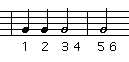 , while
someone else may count at half that speed, and conclude that a pattern
has three of these slower beats:
, while
someone else may count at half that speed, and conclude that a pattern
has three of these slower beats:  .
.
This problem occurs not just for two-step, the same question arises
for the country dances pony and polka. The rules of the
UCWDC put these dances at 110 and 120 bpm respectively, but I am of
the opinion that that should be 220 and 240.
Counting at half speed is natural as music speeds up: as
articulating one two three four becomes harder at high speeds,
there is the temptation to "shift down a gear" and count at
half speed. Likewise,
for very slow music there is the temptation to count at double the
real speed.
In a way, the question of what the "real" tempo of a
piece of music is can not be settled unambiguously. Music notation is
flexible, and any piece of music can be written any number of
ways. However, in the context of dance music we can bring other
considerations to bear.
A lot of dance music, and certainly anything country and western,
is backbeat-based. That is, there is a recognisable alteration of
downbeats, characterised by a note on the bass drum and/or bass
guitar, and backbeats, almost invariably with an accent on the snare
drum. For dances such as West Coast Swing, Hustle, Chacha, everyone
agrees that they are around 120 bpm, and this tempo agrees with the
snare drum pattern you typically hear. For Nightclub Two-step, most
people agree that it is around 65 bpm, although I have heard of people
dancing foxtrot to a slow N2S song, and claiming that the music was
130 bpm. However, the snare drum pattern in N2S puts it at 65bpm.
Now, applying the same principle to Two-step, Pony, and Polka, we
find that the snare drum pattern leads to an inferred tempo of around
200 bpm -- and over that number for Pony and Polka. Also, in some
songs you wil hear the same drum pattern appear across different
dances. For instance, Clint Black's No time to kill uses the
typical polka pattern, only slower. So, shouldn't that imply that
polka is faster than two-step?
Of course, despite these sort-of hard arguments for the
"true" count of a dance, practical considerations of
choreography may dictate a pragmatic count that is different from the
one found from musical considerations. For instance, counting two-step
as 1&23 has the great choreographical advantage that you
step on every "beat", which makes mapping a routine a lot
easier.
Other time signatures than 3 or 4
In ballroom dance and related forms such as latin, swing, country, all
dances have either three or four beats to the bar. In folk dancing on the
other hand, in particular non-western folk dancing, one can encounter bars
with five, seven, or nine beats.
Even apart from dance music, time signatures with other than three
or four beats to the bar are quite rare in western popular and
classical music. The best known exceptions are some compositions in
five quarter time: the theme from the tv series Mission Impossible
and the jazz standard Take Five played by the Dave Brubeck Quartet,
both with a 3+2 feel, and the second movement from Tchaikovsky's fifth
symphony, which has a 2+3 feel.
Syncopation
The term "syncopation" is used both in music and in dancing.
The dance meaning of the term is derived from the musical meaning, but there
is considerable difference in the details. In both cases, the meaning could
be described as 'putting notes/steps where they were not'. In music, syncopation
refers to taking notes that would be on the beats and moving them
forward or back to fall in between the beats. In dance, syncopation
involves not moving steps about, but rather adding them in between beats.
In music, the intended meaning of syncopation is to establish a rhythm
counter to the original rhythm. Thus, syncopated rhythms can be considered
as a shift of an original rhythm that was completely on the beat (Movie:
small and large).
Another way of stating it is that normally unaccented, or weak, beats are
now accented. Here is a definition taken from the New Grove Dictionary of
Jazz:
In measured music an effect of rhythmic displacement
created by articulating weaker beats of metrical positions that do not
fall on any of the main beats of the bar, while stronger beats are not
articulated.
Slightly more elaborately, here's the definition from the New Grove
Dictionary of Music and Musicians:
The regular shifting of each beat in a measured
pattern by the same amount ahead of or behind its normal position in
that pattern [...] Syncopation, as it is most widely understood, is
restricted to situations in which the strong beats receive no
articulation. This means either that they are silent [...] or that
each note is articulated on a weak beat (or between two beats) and
tied over to the next beat [...]
Lots of words, eh? If you keep in mind that in spirit a syncopation is the establishment of a shifted pulse, here is *cough* Victor's 99% infallible syncopation recognition criterion: A rhythm is syncopated if there occur two consecutive notes in between beats.
In dance, the term syncopation is also used, and it refers to dance steps
occurring in between beats. For example, in west coast swing there is a
popular variation on the basic footwork where the step-step on beats
1 and 2 changes to point-step-step in the 1&2
rhythm. Here, the step action that would normally occur on the first beat
has shifted back by half a beat. However, unlike in musical syncopations
where the beat itself would have no action associated with it, here another
action is added on the beat.
You could also say that an action has been added in between the beats:
there used to be two actions and now there are three. This adding of steps
also occurs in other dances, for instance in waltz 12&3 is a
syncopated pattern.
Another form of syncopation is to take an in-between-beats action and
move it to another location. For instance, again in west coast swing -- the
dance that virtually has a patent on syncopation -- the first four steps
of a pattern 12 3&4 can change to 12 &34. Here, the
location of the in-between-beats action has moved forward one beat.
Here is the definition by dance authority Skippy
Blair:
[...] the rearrangement of the weight changes within
the 2-beat Rhythms. [...] Stepping before the beat [...] and then
stepping again, or doing something else on the actual beat of the
music. Example: count "&a1". Lift your knee on the
"&", step on the "a" and "kick" on
count "1".
This then seems to be the interpretation of the term
"syncopation" in dancing:
- an action in between beats or before a beat is inserted where none
appears in the basic rhythm, while the actual action on the beat can be
altered, for instance from a weight change to a point or kick; or
- an action in between beats is moved from its normal position to one
where normally no such action occurs.
However, none of the syncopated dance rhythms above would be
considered syncopated in music, because no action appearing on a
beat has been removed. It is very rare for there to be a dance
action in between two beats without there being an action on the
second of the beats. The only true syncopation I have ever come
across in dance is a timing change in hustle, where the normal
23&1 was replaced by 2&(3)&1 without any
added actions on beat 3.
In summary, dance syncopations and musical syncopations
have similarities in spirit, but large differences in practice.
Footnotes
Ok, not quite for chacha and
international rumba; we will
get to that later. Even in those dances, though, the basic rhythm
repeats every bar, and the footwork every other.
| Contents |
This file is part of "Feel The Beat", a musicology course for dancers, by Victor Eijkhout (victor at eijkhout dot net), who appreciates being sent additions or corrections on the material in this course. Copyright 2000/1 Victor Eijkhout.
You may link to this page but you may not make copies for private use in any form, electronic or physical. (Obviously the copy in your browser cache is needed, but you must let this be purged in the normal way.)
Reproduction in any means such as book or CDROM is especially not allowed. When you link to this page, the page may not be displayed in a frame: use the full window, or open a new one.
It goes without saying that Victor takes no responsibility for
any inaccuracies in the information presented here or for any
use or abuse of this information. Victor is neither
a doctor nor a lawyer, so do not follow his advice.
URL: http://www.eijkhout.net/ftb/text_files/Beats.html
Last modified on: Sunday, May 6, 2001.