 , that is, one
heavy beat and two lighter ones.
, that is, one
heavy beat and two lighter ones. In this section you will learn about the concept of beat, and its relation to rhythm and musical patterns. If you haven't done so, please read the introduction to music notation.
Beats are what you count: if the band leader counts down "One, two,
three, four!", he has just counted four beats. In some music the beat
is very easy to hear. For instance, in some bluesy music the bass may play
a walking bass pattern. Example: Lou Rawls Fine
Brown Frame, Johnny Lang Rack
em up.
A bar is a repeating group of beats, for example three counts in a waltz (this is called a ternary
rhythm) and two or four counts in most other dances (this is called
a binary rhythm). Usually you can
easily recognise the bars.
Waltz has a distinct "Oom pah pah" feeling, that is, one
heavy beat and two lighter ones.
For the rhythms of most other dance the feel is "Left right"
or "Up Down", that is, two beats. A lot of music
has four beats to the bar, often with a clear "left right left right"
feel.
A lot of music
has four beats to the bar, often with a clear "left right left right"
feel.
It is a matter of convention and tradition whether binary rhythms are presented as having two or four beats to the bar. Traditionally, Samba, Polka, and Paso Doble are presented with two beats to the bar; all other binary rhythms are notated with four beats to the bar.
Sometimes it is open for debate what exactly the beats are in a piece
of music. One person may hear as one beat what another hears as two beats.
For instance, country two-step is a relatively fast dance, so one person
may hear beats that are approximately 1/3 second long, and of which there
are six in a pattern: 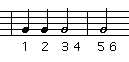 , while someone else may count at half
that speed, and conclude that a pattern has three of these slower beats:
, while someone else may count at half
that speed, and conclude that a pattern has three of these slower beats:
 .
.
Musicians who start to dance are almost invariably puzzled or confused
by the fact that music with four beats to the bar is used for dances that
have six (as in swing, foxtrot,
country two-step) or three (as in hustle)
beats to the pattern. "It does not fit."
This is true. A single pattern can be shorter or longer than a bar of music.
There is nothing but to get used to this fact. However, two six-beat patterns
together fill up three whole bars of music. For example, in country two-step:
 , so the third - and in general every other - pattern will again start
at the beginning of a measure.
, so the third - and in general every other - pattern will again start
at the beginning of a measure.
Such dances where the pattern has a different length from the measure
length are also confusing if you start counting. Do you count the beats,
or the steps? Again, in two-step:  where the beats are counted
over, and the steps under, the rhythm.
where the beats are counted
over, and the steps under, the rhythm.
Most dances that have a pattern length unequal to the bar length at least
have an even pattern length. This means that patterns will always start
on an odd beat, and the upbeat/downbeat pattern is the same always. Hustle is the exception here. In the
simplest way of looking at this dance, the basic patterns are three beats
long, so they alternate starting on odd and even beats. This usually confuses
the heck out of beginning hustle dancers.
Finally, it should be noted that dances such as Rumba
and Cha-cha also have a pattern
length that is different from the bar length. However, here the pattern
is simply two bars long, so this is usually not felt as something worth
remarking on.
To make the dance bear a relation to the music it is set to, good dancers
will fit dance phrases to musical phrases. For instance, a lot of music
has 32 beats in each chorus or verse. A dancer can use four 6-count and
one 8-count pattern to line up the dance with the music: 
In ballroom dance and related forms such as latin, swing, country, all
dances have either three or four beats to the bar. In Folk Dancing on the
other hand, in particular non-western folk dancing, one can encounter bars
with five, seven, or nine beats.
Time signatures with other than three or four beats to the bar are quite
rare in western popular and classical music. The best known exceptions are
some compositions in five quarter time: the theme from the tv series Mission
Impossible, and the jazz standard Take Five played by the Dave Brubeck Quartet,
both with a 3+2 feel, and the second movement from Tchaikovsky's fifth symphony,
which has a 2+3 feel.
This does not at all mean in dance what it means in music.
This file is part of "Feel The Beat", a musicology course for dancers by Victor Eijkhout (victor at eijkhout dot net), who appreciates being sent additions or corrections on the material in this course. Copyright 2000 Victor Eijkhout.
You may link to this page and make copies for private use in any form, but reproduction in any means, including book or CDROM, is not allowed without permission from Victor. When linking, the page may not be displayed in a frame: use the full window, or open a new one.
It goes without saying that Victor takes no responsibility for any inaccuracies in the information presented here or for any use or abuse of this information. Victor is neither a doctor nor a lawyer.
URL: http://www.eijkhout.net/ftb/text_files/Time.html
Last modified on: 2000, Thursday August 17.