Beat subdivisions
Only for arithmetically inclined nitpickers I want to belabour the matter
of subdivisions of the beat. This is an advanced topic; before you study
this, please make sure you have seen the introduction
to music notation, in particular the section about triplets;
it would also help if you had first read the sections on swing,
chacha, and samba.
Now to business.
We have the concepts of
- divisions of the quarter note in two eights, three eighth note triplets,
or four sixteenths, and
- the various ways dances subdivide beats, such as 4&1 in cha-cha,
or triple-step in swing, and the smaller subdivisions that are used in
samba.
First look at subdivisions of a quarter note.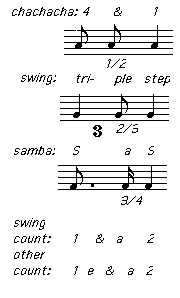 The division
in four sixteenths is a subdivision of that in two eights. That is because
two sixteenths fit in one eighth note. One way you can see this is by giving
names to all the subdivisions. Some people count 1e&a2. The chacha
steps then fall on the 1, the &, and the 2. The
samba steps fall on the 1, the a, and again the 2.
The division
in four sixteenths is a subdivision of that in two eights. That is because
two sixteenths fit in one eighth note. One way you can see this is by giving
names to all the subdivisions. Some people count 1e&a2. The chacha
steps then fall on the 1, the &, and the 2. The
samba steps fall on the 1, the a, and again the 2.
If we try to fit swing into this, we run into a problem: the triple step
is based on a subdivision in three, not in four. Some people pronounce the
swing subdivisions as 1&a2. The steps in a swing triple step
are then on the 1, the a, and the 2. Can you see the
confusion? Both swing and samba step on a beat subdivision named a,
but those subdivisions are not the same. In swing the a comes at
2/3 of the beat, whereas in samba it comes at 3/4. Likewise, chacha steps
on a subdivision named &, but that is not the same &
as the one in the swing count. The chacha & is halfway between
two beats, and you actually step on that subdivision; the swing &
is at 1/3 of the beat, and you don't step on it, it is only a counting aid.
For even more confusion, swing is also danced to music that can not traditionally
be called "swing music". In that music there are no instruments
playing triplets: they play at most eighth notes (sixteenth notes are rare
in swing music), that is, the 1&2 rhythm. The problem with this
is that now all of a sudden, in order to dance to the music, the "ple"
part of a triple-step falls on the &, and no longer on the a.
| Contents |
This file is part of "Feel The Beat", a musicology course for dancers, by Victor Eijkhout (victor at eijkhout dot net), who appreciates being sent additions or corrections on the material in this course. Copyright 2000/1 Victor Eijkhout.
You may link to this page but you may not make copies for private use in any form, electronic or physical. (Obviously the copy in your browser cache is needed, but you must let this be purged in the normal way.)
Reproduction in any means such as book or CDROM is especially not allowed. When you link to this page, the page may not be displayed in a frame: use the full window, or open a new one.
It goes without saying that Victor takes no responsibility for
any inaccuracies in the information presented here or for any
use or abuse of this information. Victor is neither
a doctor nor a lawyer, so do not follow his advice.
URL: http://www.eijkhout.net/ftb/text_files/Subdivisions.html
Last modified on: Sunday, May 6, 2001.